
Create
Artwork Concepts
"Multimodal/Crossmodal Affectivity" Aiming to extend and transform experiences through cross-sensory interaction. Reference paper
- Color / Sound / Texture / Smell / Taste -> See / Hear / Touch / Smell / Taste
- Sonification (making tactile sensations and actions audible)
"Enactive Affectivity" Constructing environments where sensory interest and reflective ("thought-provoking") interest are explored and emerge through the experiencer's actions (interaction with devices).
- Pursuing the artistic expression of fidget toys --- objects you cannot help but want to touch
"Digital Kineticism" Constructing environments where materialized information, informatized matter, and experiencers mutually interact and co-constitute through "movement" as a medium.
- The appeal of materials, materiality
- Making (usually inaccessible information) tangible through "movement" and physical manifestation
"Hapsonics" Exploring and practicing the significance of tactile sensation in acoustic expression. (A derivative theme of "Crossmodal Affectivity")
Raising the Quality of Your Artwork
1. Separate Everyday Space from Artwork Space
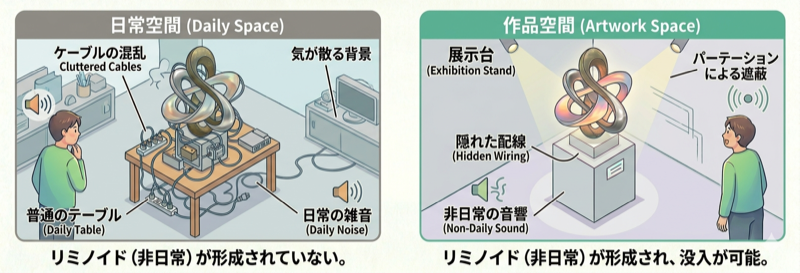
Creating a liminoid ("non-everyday") space is a fundamental prerequisite for allowing experiencers to immerse themselves in the artwork world. The elements that separate the everyday from the non-everyday are often less about the artwork itself and more about the surrounding environment --- the display stand, cables, and background (sounds). It is important to use dedicated exhibition stands instead of regular tables, partition off the space, and ensure that unnecessary wiring is not visible.
TIP
There are also forms of art embedded in everyday life, such as public art.
2. Minimize Explanations During the Experience
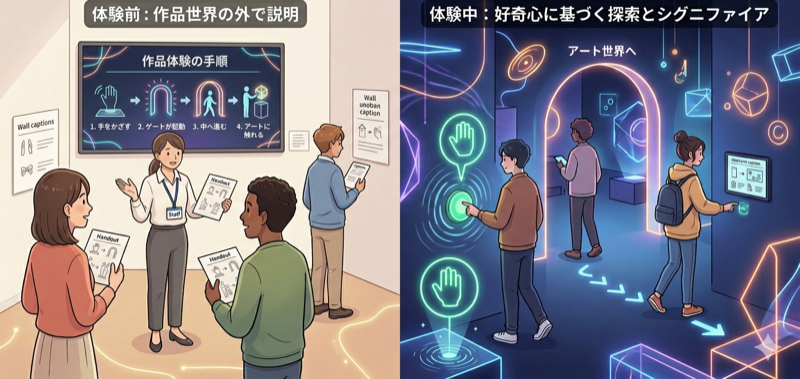
It is better to complete explanations about how to experience the work outside the artwork's world. Explanations should primarily be delivered through captions, slides, handouts, etc., supplemented orally, to send the experiencer into the artwork world.
Just as shrine visits follow the ritual of two bows, two claps, and one bow, art spaces operate under special rules different from everyday life. Therefore, the rules of this world need to be carefully communicated. However, the presence of the artist or explanations during the experience can hinder the experiencer's curiosity-driven exploratory behavior. Within the artwork space, in addition to captions, it is important to design features such as signifiers on the device (a button naturally encourages pressing) to make the flow of the experience intuitive.
3. Don't Turn the Experiencer into a Puppet
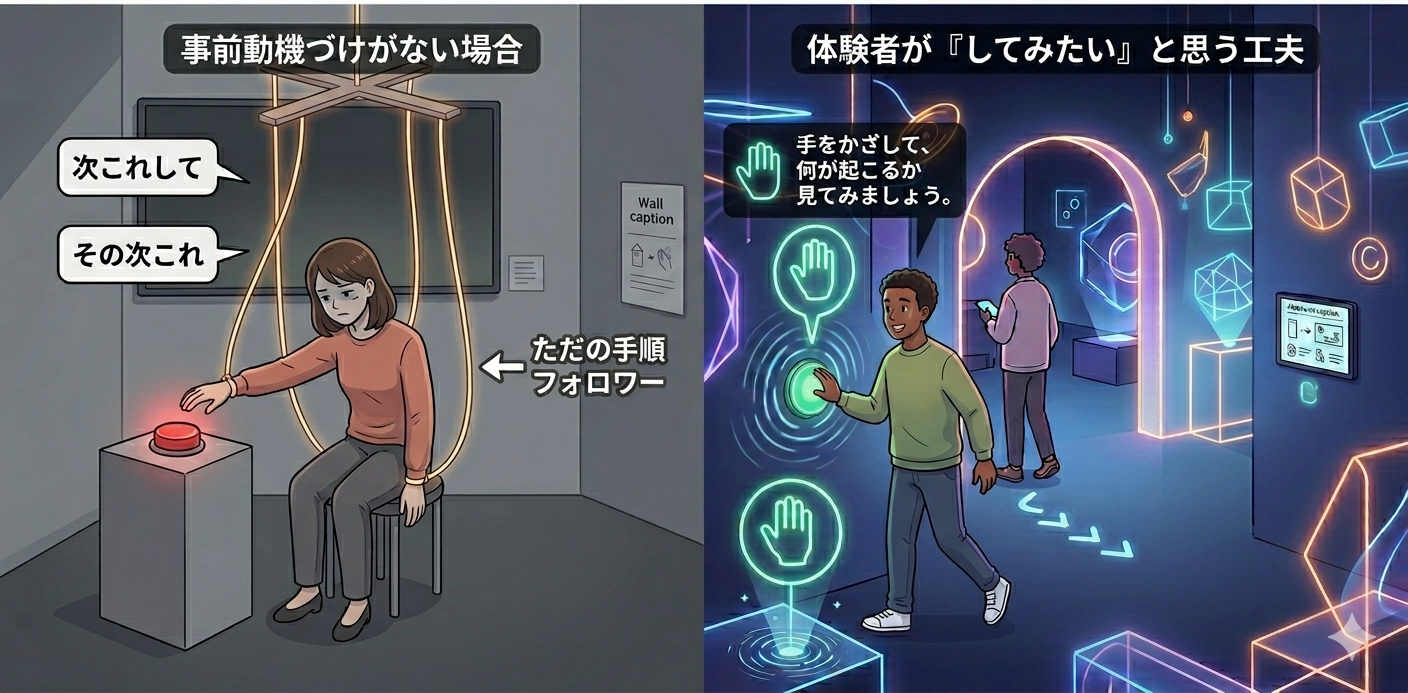
When a series of operational steps are required to experience the work, forcing specific operations without first motivating the experiencer turns them into a mere puppet. In addition to signifiers within the work, use captions, slides, handouts, audio announcements, etc. to make the experiencer want to perform those actions.
4. Have Someone Unfamiliar with the Work Try It
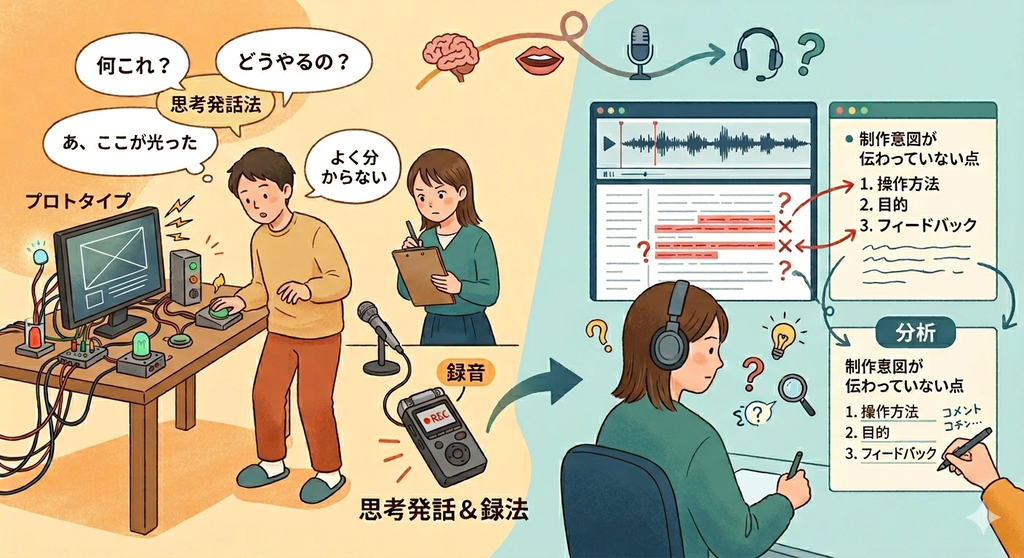
Have an acquaintance or friend try the experience and ask them to verbalize everything that comes to mind (think-aloud method). Record it and use it to identify where your creative intent is not being communicated effectively.