
Group Work
Group Work: Becoming Aware of Affective Value in Everyday Life
Overview
Discuss concepts that emerge from combining various everyday objects and phenomena with various impressions (onomatopoeia, adjectives, sense of ___).
Procedure
- List as many impression-describing words as you can think of, and number them sequentially. (15 minutes, goal: 50 words)
- Classify the impressions (20 minutes)
- Visual, auditory, tactile, olfactory, gustatory
- Other sensory impressions (e.g., fidgety, heart-pounding)
- Other abstract impressions (e.g., sense of luxury, primitive, futuristic)
- List as many everyday objects as you can think of, and number them sequentially (goal: 50 items).
- For randomly paired combinations of impressions and objects, if such a thing were to exist:
- What shape would it have? (Ideally, draw it!)
- What color would it be?
- What would it feel like to touch?
- What sound would it make?
- (What would it smell like?)
- (What would it taste like?)
- Would it be useful (does it have value)?
- Share each group's combinations.
Group Work: Generating Ideas for Expressing Affective Value
Overview
Generate ideas for new expressions by combining various everyday objects, places, etc. with impressions linked to value.
Procedure
- Classify all the impressions you listed into the following three categories: Positive | Negative | Ambiguous / Context-dependent
- Randomly select one impression from the positive (or negative) category. List as many objects, places, etc. associated with that impression as you can, and number them sequentially.
- Randomly select one from the list, and think of ways to express that impression without directly presenting the word or the actual thing.
Group Work: Becoming Aware of Sense-Making
Purpose
Become aware of the process of sense-making (meaning generation) through interaction with objects (action-perception loop), and understand enactivism.
Procedure
- Touch and explore the object given to each group
- List what actions produce what sensations or results
- Think of as many uses and values as possible for the given object
- Find objects that could be used for this group work activity
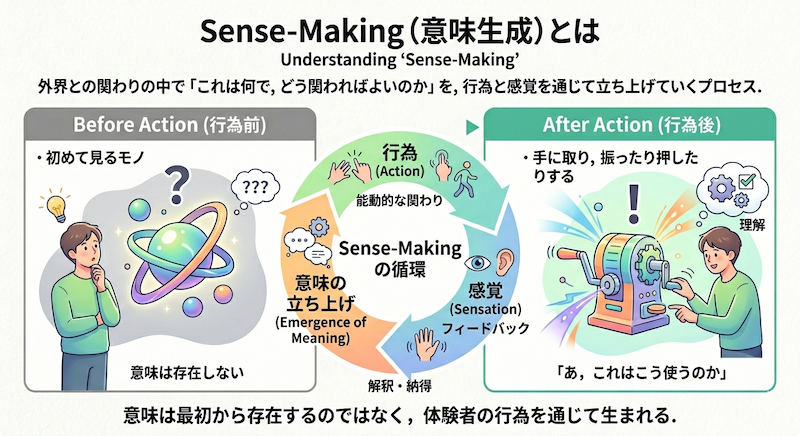
What is Sense-Making?
The process of establishing "what is this, and how should I engage with it?" through engagement with the external world, via actions and sensations. For example, the process of picking up an unfamiliar object, shaking it, pressing it, and gradually understanding "ah, this is how you use it" is sense-making. Meaning does not exist from the start --- it emerges through the experiencer's actions.
Enactivism
The idea that meaning in the external world is discovered through action upon it, and that action and perception are inseparable. In contrast to the traditional passive perception model of "receiving information through eyes and ears and processing it in the brain," enactivism holds that "the world only becomes visible through reaching out and moving around." See the Keywords page for details.
Reflection
- In artworks, the model where "the artist's message or concept comes first, and the experiencer receives it" tends to overlook the process of sense-making, where the experiencer discovers the artwork's value through an action-perception loop with the work.
- The artist's message or concept should be thought of as a "seed" that blossoms into value only through the experiencer's engagement.
Group Work: Opacifying Sense-Making
Purpose
By deliberately pursuing different directions of sense-making with familiar objects, become re-aware of "meaning acquired through interaction with objects" that has become unconscious.
Procedure
- Touch and explore the object given to each group
- List what actions produce what results
- Think of as many alternative uses as possible for the given object
- Find objects that could be used for this group work activity
Reflection
- Interaction with familiar objects is highly predictable --- the meaning of the object has become unconscious/transparent
- Transparent meaning serves as useful signifiers that guide the experiencer's appropriate behavior
- At the same time, presenting new experiences that exceed or defy the experiencer's expectations re-opacifies (makes conscious again) the experiencer's sense-making
- The process of rediscovering meaning from an opacified state connects to the subjective value of experiential art
Turning Everyday Things into "Research Questions"
Purpose
Identify "research questions" from everyday things that can serve as starting points for affective informatics research or artwork creation.
Procedure
- Choose one keyword from the randomly presented keywords
- List sensations, perceptions, impressions, values, problems, etc. related to that keyword
- Classify them into the following three categories: Positive | Negative | Ambiguous / Depends on the person or context
- Select one positive or negative item and analyze/hypothesize why it is so.
- Select one ambiguous/context-dependent item and analyze/hypothesize under what conditions it applies.
- Summarize the content of steps 4 and 5 on one slide each and share
Reflection
- In practice, sometimes a research question comes first, and other times it emerges while developing a research subject or artwork concept
- Research questions are not limited to widely recognized societal problems --- they can include things not yet recognized as problems, things that are unclear as problems, or things not yet put into words
- For unclear problems, "externalization" through artworks is an effective approach
- Other standard methods include surfacing problems through interviews and surveys